
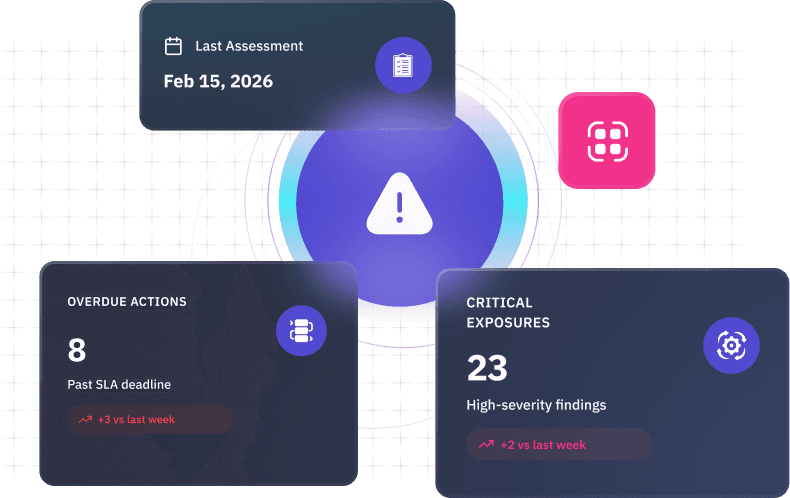
For modern security, sales, and procurement teams, vendor onboarding has become a massive administrative bottleneck.
The Old Way: Platforms like Vanta, Drata, Sprinto, Secureframe, Hyperproof, Scrut, Scytale, and AuditBoard operate simply as postmen. When you need to assess a new supplier, they carry a long, 50-plus question spreadsheet form to the vendor’s inbox. Your procurement pipeline stalls for days or weeks while you wait for a response, followed by hours of manual sorting to spot hidden risks.
The Secure Cohort Way: Apply Cyber works like an active digital detective. Secure Cohort completely automates your external risk pipeline by removing the questionnaire barrier. By entering a vendor’s website domain URL, you trigger an immediate, independent scan of their live infrastructure, providing a prioritized threat breakdown and a definitive Security Score in minutes.
Secure Cohort is engineered to separate active external asset testing from static internal checklist management, giving you absolute visibility over your data ecosystem.


The Questionnaire Trap
Traditional platforms block your operational flow by forcing third parties into localized portals to fill out self-reported risk assessments. Secure Cohort runs on zero-wait automation. The exact moment a domain URL is submitted, the platform executes an instant perimeter scan. Procurement can make software selections and evaluate vendor reliability during the very first call, completely avoiding the traditional weeks-long tracking cycle.
vs. Self-Reporting Bias
When a vendor answers a compliance form, they provide static, idealized answers that often hide background infrastructure errors. Secure Cohort scans the vendor’s actual operational reality. The platform actively inspects live server configurations, active encryption layers, and public-facing asset vulnerabilities, catching outdated protocols or open misconfigurations that self-reported questionnaires systematically miss.


Breach Detection.
A clean compliance check today doesn’t account for past negligence. Secure Cohort dives deep into the target domain’s technical history, cross-referencing global exploit registries and historic database exposures. It uncovers past data leaks, historical security blunders, and recurring breach patterns, giving your security team a clear view of a partner’s long-term operational reliability.

& Criticality Classification
Not all vendors possess the same level of data access. Secure Cohort automatically categorizes your third-party ecosystem by risk profile (High, Medium, Low). By analyzing how deeply a partner integrates with your network or stores sensitive customer data, the platform filters out unnecessary noise, focusing your team’s energy on high-criticality data processors.


Calculated from active scans, control maturity, and monitoring signals.
Monitoring
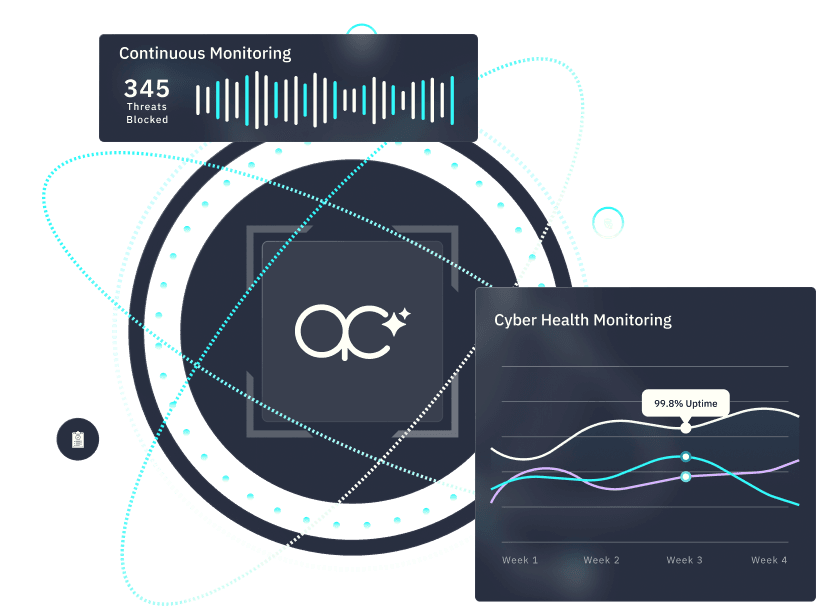
Legacy tools perform vendor risk checks as a single, one-off event during procurement. Secure Cohort provides continuous infrastructure monitoring. It constantly tracks your entire vendor list long after the contract is signed, sending instant alerts straight to your team if a critical software bug or architecture vulnerability develops on a vendor’s domain months down the line.

GRC Ecosystem Synergy.
Beyond stand-alone diagnostics, Secure Cohort compiles these findings into clean, professional executive scorecards designed for quick management sign-off. Because it lives inside the broader Apply Cyber ecosystem, all third-party risk profiles automatically sync with your internal policy structures (GovernAI) and audit-readiness modules (AutoCert), instantly alerting you if an active vendor falls below your corporate compliance thresholds.
Here is how the step-by-step operational journey of onboarding and verifying a new third-party vendor scales under both approaches:
| Operational Process Step | Traditional GRC Platforms (Vanta, Drata, Sprinto, Secureframe, etc.) | Apply Cyber Platform (Secure Cohort Module) |
|---|---|---|
| 1. Initial Risk Action | Search for contact info and email a lengthy questionnaire portal link to the vendor. | Paste the vendor's domain URL straight into the Secure Cohort engine. |
| 2. Data Collection Pipeline | Chase down the vendor via email; wait days or weeks for their team to respond. | 0 Seconds Waiting: The automated scanner crawls the perimeter instantly. |
| 3. Vulnerability Analysis | An internal expert must manually read through pages of text to spot security issues. | AI Diagnostics: The engine flags precise system flaws (e.g., weak encryption) automatically. |
| 4. Criticality & Tiering | Manually classify vendor threat profiles using disconnected spreadsheets or notes. | Automated Classification: The system groups the vendor into High, Medium, or Low risk tiers. |
| 5. Policy Synchronization | Manually verify if the vendor's settings align with your internal security policies. | GovernAI Integration: Automatically alerts your team if vendor specs break internal rules. |
| 6. Audit-Ready Reporting | Manually gather files, screenshots, and emails to prove the vendor check to an auditor. | AutoCert Dashboard: Live vendor health metrics stream directly to a secure auditor link. |
| 7. Ongoing Safety Lifecycle | The vendor profile remains static until a manual annual review is scheduled. | Continuous Monitoring: Active alerts trigger immediately if a zero-day exploit impacts the vendor. |
| Total Process Timeline | 1 to 2 Weeks | Minutes (Same-Day Clearance) |
Traditional tools operate as passive messengers — they carry questions, gather self-reported promises, and leave the analysis on your plate.
Secure Cohort acts as an active digital detective. It scans real-world infrastructure instantly, calculates immediate risk scores, tracks historical data leaks, and keeps watching continuously so your business can onboard partners safely and scale without delays.
Experience The Future Of AI-Powered Cybersecurity Management.
Request A Demo Or Explore Our Solutions To See How Apply Cyber Can Safeguard Your Business.